
Coning Part 2

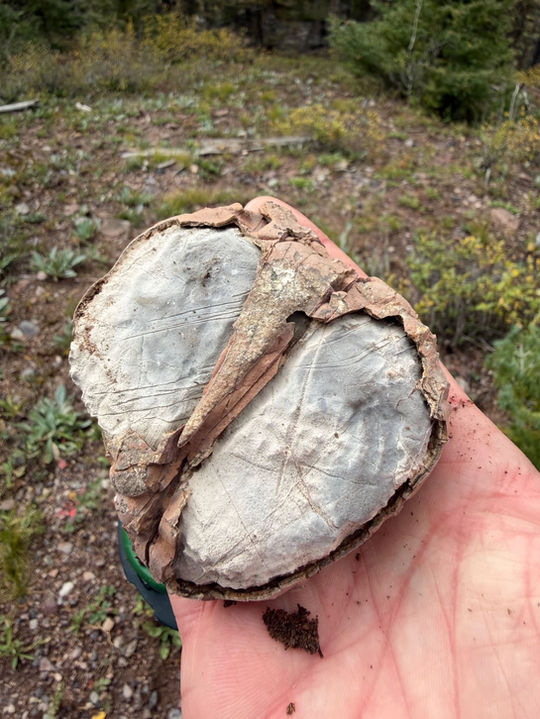
Flow coning on Mars. Now this splatter had velocity hence the flow coning. Unlike shatter cones it is not a resonate made form. The knob ending on the lower right side are from the sudden stop to the sliding of molten material. 4 August 2026.
NASA’s Perseverance Rover has discovered an object of likely extraterrestrial origin on Mars that experts say does not resemble the typical geology of the Red Planet.
The unusual rock was discovered on September 19, 2025, 1,629 days into the Mars 2020 mission, shortly after noon local time. NASA scientists have dubbed the strangely shaped rock “Phippsaksla,” making it the latest item of interest in the continued study of Mars.

That is an impactite made of iron from a meteor. Impactites are rocks made by the explosion of a large meteor hitting earth. Based on Mars which your picture landscape looks like the Earth has 1.2 million surface craters of a mile diameter or greater. Interesting shaped rocks are also found on Mars. Your rock is called a boxwork single. I have found one in the crater I currently live in made of iron. The shape is caused by resonate expansion and collapse. Resonate expansion is both resonance which is a harmonic that tends to gather in the center of mass like your microwave oven and cook from the inside out by molecular friction. However, in this case the power and wave size is enormous as those ridges are wave lengths. Expansion is the tendency of a viscous sphere to produce a bubble. While a circle is the most uniform 2-dimensional way to equal pressure the surface weakened and collapses to the corners you see which are also slightly concave. The two colors are iron 2 & 3 oxides. 4 August 2026.
Arkansas Rockhounds!
Found at the lake yesterday. Is this natural erosion? (It’s a — rainbow! Yes, I brought it home with me.

Amathist and citrine. What is unique about your meta crystal is the crystal in an overall crystal. Now take a look at the attached magnification. Besides branching a smaller cube (twinning) it has a harmonic halo line around it. Very interesting. Also, in the above picture you can see triangle twinning and fractal twinning smaller points another resonate effect, see arrow. 5 August 2026.
I’d be interested to know what this stone is. Probably a quartz? I found it on the banks of the Findhorn river .. near Ardlach church yard. Google says it’s fluorite, but I think that’s quite rare? It’s got strands of purple and there is some yellow. I’ve put a small UV light on it and it’s slightly glowy inside.


That is an impactite flow point single. The overall shape is an aerodynamic velocity based form. It was very pliable. The high energy of an earth impact melts the area and impact is a kinetic liquid liquid interaction because matter cannot stand up to that much energy. The surface is the tiny streams of explosion chaos the impactite went through. It was once bedrock and is now shock dolomite and that is why it is so heavy. 7 August 2026.
Lamar Collins
Well I found it!!
About 2 years ago me and my 5 yr old found this in a dry part of our creek among some much larger rocks of same material . Then life simply hid the rock but not my curiosity. I really wasn't sure how to go about any answers and then a couple weeks ago I found the rock again and had seen some of y'all's posts. The rock is extremely heavy and the layers for lack of a better term seem odd. I'm in villanow, North West Georgia and have walked many creek beds and never came across whatever this is except for this creek bed.

Anyone live around or know about Cumberland City, TN?
I collected shatter cones from an abandoned quarry back in the early ’90s, and I’m trying to see if I could get access to visit it again. The photo is of one from that trip. The abandoned quarry was just south of the TVA plant and near the Cumberland Project area.

Look at that lovely cusp effect at the edge of the larger cone in cone harmonic. That is a harmonic triangle wave differential, a smaller follow-on fractal harmonic wave. It is what you know as an octave shift. 16 August 2026.
David Doyle specimen.

Impactite, blue crypto crystalline flint with iron from the meteor on outside. This is rare. The layers ae made by a pulse shock wave. It has reverse umbrella flow points. Do not alter it. The iron arrived very hot and makes a mosaic surface. As this is the only example of its type I have seen I need to add it to the bottom of my page/chapter on impact made points. While not a shatter cone I put all the points like this reverse flow points in one grouping. 7 Sept. 2026.
Earlene Fornshell
Anyone know what this might be? Found it with a friend in her rock garden in Peoria IL. A knife can't scratch it, but it can't scratch a knife. It has what I think is a lot of iron on it. I'd love to take it off but only in a safe way. So I'm asking what it might be, & if I should try to get the iron off &, if so, how.


Chert impactite. The significant mid specimen conical impression was made by a plasma bubble cavitation. Inside the cavitation are fiber crystals. Fiber crystals from Earth Impacts usually arrive late in the explosion process welding to the surface. The specimen is a series of flow points which were a simi liquid when formed. The surface iron came from the meteor. While not a shatter cone I keep up a study of flow points alongside shatter cones as they both make a pointed structure. 7 Sept. 2026.
Matthew Penn
Ok guys, I have a question. I found both of these points in the exact same spot . I know the one in the left is a legit artifact. But I can’t find out if the zig zag one in the right is an actual point or just a something nature created? Please let me know what you think. Any advice and expertise in to what this may be ; is much appreciated

Flow coning, notice it only has the one point propagation. 11 Sept. 2026.
Geology of North Carolina
Meant to share this last week: drilled a bridge in Haywood County. Gorgeous migmatite.

Meteor marbled bolder with actual sign wave cone in cone propagation. This bolder was not made as part of some deep tectonic pressure it was formed as the boulder you see and landed in situ. That is a unified origin theory. By the law of parsimony it is a single process and therefore highly likely compared to the multi step unconnected event theory that is still taught. 11 Sept. 2026.
Geology of North Carolina
Meant to share this last week: drilled a bridge in Haywood County. Gorgeous migmatite.

Midcrustal 2.4 to 3 billion year old migmatites (a rock that incorporates both metamorphic and igneous materials) of the Levack Gneiss Complex are found immediately outside of the north rim of the Sudbury Igneous Complex. SUDBURY IMPACT STRUCTURE – Crater Explorer

Impact sphere inclusions. The Sudbury impact structure – top surface of the Chelmsford Formation. 15 Sept. 2026.

Impactite nodules. The dark cores flint are the result of high power shock resonance which gathers around the center of mass and cooks from the inside out like your microwave oven. The coning/triangle forms are a pointed waveform triangle wave. It is a type of shatter cone. The cross hatching with cells is a type of impact bricking where crossing waves make squares or rectangles like you see with pond ripples. This is a complex interaction of crossing shock waves and the triangle wave cooking it by resonance. Chert surrounds the flint. The white surface is a late arriving mineral splatter as impact is a progressive explosion event. Attached is a geology map showing your craters. Quarries like to locate where hard metamorphic rocks can be mined and are often located in craters without knowing it. 17 Sept. 2026.
Arkansas Rocks and Minerals
Annette Seaman ·12 hours ago ·
Can someone tell me what this is? Found in driveway gravel near Mena, Arkansas. Thanks !

Harmonic fanning. This is no fossil anybody recognizes. It most resembles columnar basalt. It is a radial imprinting. This is from an Earth Impact into sand. The trace iron 2 is from the meteor itself. The columns are liquid bubble spheres contained into tubes blasting outward from a central point however I have never seen such thin flow points. It is the most extreme example of a thin triangle wave in three dimensions. You can also see tube points along the geometric surfaces; they appear as sinusoidal. The left side rock has mosaic cracks in the tubes. 21 Sept. 2026.
Texas RockHounds
This was found in a sandstone bank in La Grange. Is it some sort of fossil or just some weird break ?


Note the expansion fan in this diagram. 21 Sept. 2026. Numerical Investigation of Mach 2.5 Axisymmetric Turbulent Shock Wave Boundary Layer Interactions

Ahh, hypervelocity changes the shape of the radial wave form. Interesting. 21 June 2026. PPT - Center for Radiative Shock Hydrodynamics Fall 2011 Review PowerPoint Presentation - ID:2588927

Now here we have some very thin coning and even a separating coning trench. Sept 22 2026
An example of a shatter cone, which is a piece of limestone with striations that were formed when it was “shocked” during an impact event. It was collected in the Steinheim Basin in Germany. This stone is 13cm / 5 in across. Space rocks are for everyone - Planetary Science Institute

V shaped fossil impressions. 22 Sept. 2026.

While the roundish nodules on the right are impact spheres most likely, this specimen looks more like a fossil. 23 Sept. 2026. Stephen Baca specimen.

This is the closest fossil in appearance I have found. 23 Sept. 2026.
3.3" Pennsylvanian Fossil Horsetail (Calamites) Plate - Kentucky
-
This is a 1.8" fossil horsetail (Calamites) stalk, from the Breathitt Formation, Leslie County, Kentucky. Calamites is an extinct genus of tree like horsetails from the Late Carboniferous, Pennsylvanian aged forests that formed the coal shales of Kentucky and Ohio.
It comes with an acrylic display stand.
SOLD
SIMILAR ITEMS
NOTIFY ME OF NEW LISTINGS
DETAILS
SPECIES
Calamites suckowii
AGE
Pennsylvanian (~300 million years)
LOCATION
Leslie County, Kentucky
FORMATION
Breathitt Formation
SIZE
1.8" horsetail, 3.2 x 2.4" rock
CATEGORY
ITEM
#112893

Impact sphere. It is a shock made metamorphic. Impact spheres are melt drops from an Earth Impact. The amount of dirt covering it represents time since the impact. The red is manganese. It has flow coning on the surface see the attached picture. The size is a relative function of the size of the impact. I hope you don't mind but I need to add your specimen to my encyclopedia as you just don't see them with such good flow coning on the surface. So what is flow coning? It is the triangle points going one direction and is caused by the velocity it was going and the melt surface. While flow coning on your specimen resembles shatter coning the cause is different. Shatter coning is a harmonic impression of triangle wave forms. While your specimen certainly contains iron 3 from the meteor magnetism is not relevant as impact alters minerals at a fundamental level. 24 Sept. 2026.
Betty Bernal AndTroy Bacon
This rock was found by my father-n-law in the late 1920’s or early 1930’s on the south side of Cisco, Texas when they were using dynamite to cut through a hill to build what would later become Interstate HWY 20……it is EXTREMELY heavy & took 5 grown men to pick it up…..we have not been able to find that it’s magnetic…several workers took one home because they thought they contained gold….several methods have been tried to break one, from a 10lb sledgehammers (my husband spent a few hours trying it & didn’t even chip it), & drilling a hole into it was impossible. Do any of you have any idea what it is or how we can find out?
&, it may just be a big rock not worth a dime , but it’s a great conversation piece!

Shatter cone edge structure. Rare. First of all, these cones are very narrow. Furthermore the base of the cones has fractal structure. This is the cusp of the harmonic energy between physics forms based on power which essentially dissipated in your specimen from left to right. Morphology
Shatter cones have a distinctively conical shape that radiates from the top (apex) of the cones repeating cone-on-cone in large and small scales in the same sample. Sometimes they have more of a spoon shape on the side of a larger cone. What is missing from your coning structure is cone in cone which is a stronger harmonic. ERNSTSON CLAUDIN IMPACT STRUCTURES – METEORITE CRATERS do not consider cone in cone to be shatter coning. They are mistaken, it is just a stronger harmonic. While this is fractal coning; I have found this before in the field but not this cusp of energy forms. Circled above on left is the fractals in the base of the cones which is in cusp of coning. Circled right is a branching of coning which is also a fractal. Quarry blasting produces the low end of the force to make shatter cones which is likely how this rock was formed. Quarry blasting can make .5 to 3 Giga Pascals (GPa). 25 Sept. 2026
Anthony Girling
Not sure could be a coral fossil or the rock just cooled down that way

Now compare this strata structure to the above specimen. It is fractal coning. Western Wayne County, TN, HW 64 road cut. Not really a wall of glass. This is ash and sand from the Frankewing, TN Impact which made the Highland Rims as crater walls. It is a large hill made in a moment and shock hardened with the fractal tree flow clearly showing a lateral construction from east to west the direction of the impact blast. 25 Sept. 2026.

Now look at the circled fractal on the right upper side of this picture. See how it is making a V that is the lower energy of full-on coning. Also you will note that this crater structure is formed by multiple harmonics. You can see the wave type sinusoidal and even a circular structure on right side containing the circled fractal. Now for the striation/stria which ERNSTSON CLAUDIN IMPACT STRUCTURES – METEORITE CRATERS are also confused about implying they are scratch marks. I have contacted these guys about shatter coning and they are completely clueless. So, as you can see before branching in the picture above you have lines i.e. stria/striations. They are not scratch marks.
Jiji crater.
By Mars Reconnaissance Orbiter. Impact crater up shock explosion in plasma. The fractals will branch away from the trunk energy that forms them.

I found this limestone block a few miles from Howell, TN. On the left side you can see the fractal imprint but as you can see in the circled section the fractal finger is a cone. On the right side circled you can see linear striation ripples in the lower section and coning in the upper. 25 Sept. 2026.

When I first started publishing the mapping of the Howell, TN Impact Structure I had a cartoon trademark called Collide Claude. What I have found out over the years is the Pompas Popes of impact science are "Clueless Claude." So here is what they publish about this specimen above. "
Fig.7. Fibrous calcite crystals.
In contrast to true shatter cones they can easily be debunked by their in general fibrous internal structure. Once recognized, true shatter cones will not any longer be confused with regard to their distinctive fracture markings (Fig. 7.)

Go no farther than Wiki to see the common calcite solidification habits. Clockwise from top left: scalenohedral, rhombohedral, stalactitic, and botryoidal calcite.

So, what Clueless Claude has is the second iteration of a branching triangle/pyramid fractal. Far from debunking it just shows ignorance of the basic science of fractals and shatter cone formation including the striations. Is it any wonder so few craters are recognized on Earth with the clueless in charge? 25 Sept. 2026.

Shatter cones have a distinctively conical shape that radiates from the top (apex) of the cones repeating cone-on-cone in large and small scales in the same sample. The exact formation mechanism of shatter cones is still not well understood. Sometimes they have more of a spoon shape on the side of a larger cone. In finer-grained rocks such as limestone, they form an easily recognizable “horsetail” pattern with thin grooves (striae). The first man-made shatter cone was produced in 1959 during an underground nuclear explosion. Shatter Cones - Assignment Point
Sorry about the low quality of the picture but it is implied from an old source as in 1959. Not sure if the picture a is of a nuclear shatter cone but look how narrow the coning is. Coning can be lines i.e. striations. 25 Sept. 2026.
You need go no further than a search to find out twinning calcite is an indicator of impact deformations in calcite. 26 Sept. 2026.
Meteoritics & Planetary Science
Article
Open Access
Twinned calcite as an indicator of high differential stresses and low shock pressure conditions during impact cratering
Lina Seybold, Claudia A. Trepmann, Stefan Hölzl, Kilian Pollok, Falko Langenhorst, Fabian Dellefant, Melanie Kaliwoda
First published: 02 August 2023
https://doi.org/10.1111/maps.14056Digital Object Identifier (DOI)
view metrics
Editorial Handling—Dr. Michael H. Poelchau
Impactite nodule. The matrix is what once was bedrock. The mixed iron coating is a later spray as the matrix passed through more molten material. The coating has directionality as you can see it is making a flow point. 28 Sept. 2026.
Cubby Caldwell
Is this anything special? The red exterior was also hard as stone.

Impactite, shatter cone harmonics, variations and harmonic noise. Take a look at the attached magnification. Circled in the lower left is a coning variant. The major figure is a harmonic triangle wave form in two dimensions. While the three dimensional cone is a common impactite reference, the same wave form can imprint in two dimensions. The left side is a less organized harmonic noise. On the right side is even a bow type wave impression a sine wave which precedes the triangle wave development. The arrow is pointing to the central development a circle to sine wave arc to triangle points. 8 Oct. 2026.
Geo Lens
My uncle found this rock in 1947 during a dig in midtown Manhattan for a new building. He thinks it’s something, his wife just thinks it’s a dumb rock. Help!

You can see some of the same features only larger in this picture. See the circular features in the upper rock surface, then it all graduates to coning harmonics. While this is thought to be a plate tectonic orogeny it is not. First of all, it is on the surface which impact tectonics explains easily whereas plate tectonics requires some crash fold process and then it is brought to the surface flat. That is an extra step compared to impact tectonics. Also, the development from circle to sine wave to triangle wave is harmonic in origin.

Impactite cinder in crypto crystalline chalcedony, with blast sphere pitting and shatter cone inclusion with tiny impact sphere on top (see it magnified). Attached is some steel production slag for comparison. 9 Oct. 2026.
Colorado Rock Hounding
Does anyone know what these are


While similar to a shock tube agate these specimens are clearly coning. It is a shatter cone typology. You can see small round impactite pelting on the surface of the specimen on the right. The center voids indicate the shock vaporized that part. The iron indicates that it is an impact inclusion of iron from the meteor. Coning is a resonate triangle wave form. This encounter occurred at hypervelocity as impactites can travel at 40 miles per second (Mach 189). 13 Oct. 2026.
Kim Gartenzwerg
I think I have a bunch of similar ones found in volcanic chalcedony. Not fossils, but curious what they’re commonly called. They have beautiful thunder eggs for neighbors, but I like to give these homely nodules with spherulites of some sort a little love too.