
Round Impactite Spheroids - Part 2

Oblate impact spheroid (search on round impactite spheroids). In my encyclopedia of impact phenomena, I have so many of these I will have to start a new page, part 2 with this one as I have found the limit of web page size. They are the most posted impactite. It is one of many impact geometrics. This one is chert, but they come in most rock mineral types. The line are "false strata" in this case flow lines and it even has mosaic curvilinear crack lines. The iron on the surface is a common signature of impactites. These earth hitting meteors are so powerful the meteor iron is made into a plasma cloud and as a last step in impact rains down on the impactites. When magnified you can see the granular particle surface as the resolution of the photos is quite good. The configuration of these particles is called "Constellationing." The particles are the result of pulverization and sort to a common particle by distance. Keep in mind an impactite is a survivor rock and was far enough away to not be evaporated. The depth of this discovery indicates it could predate the Howell, TN Impact Structure which takes up all the lower counties of Middle, TN. Or it could have just been buried by the back rush of the sea 300 mya. There is a Silurian Impact exposure under the Howell Impact excavation. Magnification attached. So, let me take a moment to discuss concretion theory. First let me dispel grinding abrasion. This is not a Native American game ball its surface is irregular therefore not made by abrasion and they used round rock game balls. Precipitant chemistry - The production of precipitated silica starts with the reaction of a basic silicate solution with a mineral acid. Sulfuric acid and sodium silicate solutions are added simultaneously with agitation to water. The precipitate is small not big round balls and where does the Sulfuric Acid come from? Wouldn't a sea of sulfuric acid be toxic yet Middle, TN is full of sea creature fossils. 28 Feb. 2026.
Patricia D Naumann ·
Hi all! A friend in heavy equipment found this while digging an 8 acre pond. It came from S. Central Tn. It is very heavy for its size. Pics dry and wet with measurements. He did some damage when the bucket of his backhoe hit it and trying to get it out of the ground. Was pretty deep. I have no idea what it is so I’ll consider just about anything right now. He calls it a UFO rock.

I think this is a made and unmade impactite. The Septarian layer seems to be the layer that unmade it. The smaller impact spheres arrived just after that. It does have a slate type impact ash appearance at this level too. The Septarian figures in quartz are a charged grounding in flight as quartz is a simi conductor but
-
At high temperatures (up to ~1200 °C), ionic conductivity increases due to enhanced ionic mobility Mineralogical Society of America.28 Feb. 2026.
-
Rockhounding
-
Karl Patay ·February 26 at 9:38 AM ·
-
I got this from a friend of mine. We have no idea what it is. It’s quite heavy but is not magnetic. It’s about 3 1/2 inches in diameter and 2 1/4 inches thick. Any help would be greatly appreciated.
-
524 gr or 18.48 oz
-
Thank you— with Denise Lloyd-Patay.

Direction from left to right you can see bedrock breccia divided by the charged Septarian fractals then the iron content as well as the smaller impact sphere impalements going to the right. 28 Feb. 2026.


Oblate impact nodule. Type 2 impactite, earth surface sand and iron from the meteor. The iron is in two states of oxide the black (Fe3O4) and red (Fe2O3). The surface streaks are blast material directionally hitting the impactite. Shock is a resonate energy and cooks from the inside out like your microwave oven. As you can see the inside quartz is in a crypto to micro crystalline state and the iron has been separated outward by attenuation. The outside patterns are a granular crystal habit called Constellationing. The elongated shape is causes by velocity. Because of the crater cannon effect impact nodules can be ejected at twice the speed of the initial impact at around 20 miles per second.
Part 2 - No volcano could have made this type of specimen. It is too well differentiated for a simple melt process. Laboratory processes for the two oxides are complex. The complex forms of iron are found in "extinct" volcanos and are therefore not verified just speculative. It is highly likely that such finds are impact made. 4 March 2026.
I gound this other day looks like iron quirtz

Up splash "Impact Crater Cannon Effect." Attached is a high-speed photo of a liquid/liquid up splash in water. Why liquid/liquid? A meteor hitting earth at ten to twenty miles per second turns the two bodies into liquid because matter cannot withstand such high energy as a solid. The limit occurs in the crater bottom and sides, and the liquid is reversed by pressure as if a cannon. These pressures are measured in the Giga Pascals (GPa). The observed impactite formation pressures are found to be from 1 to 100 + GPa. The high end of this impact pressure is gas as liquid cannot withstand this high of a pressure regardless of the extreme heat as well. The gas phase further complicates the impact process, but the overall crater effect is liquid/liquid. Now notice in the picture the multi crater ring effect. That is a shock made sign wave with the cannon wall/crater wall bunching it up as it goes outward. This photo was taken early in the up splash effect but has started the reversal. 4 March 2026.

Now this is even earlier in the up splash before the cannon effect. Notice the fractal pattern outward. Fractals are an energy signature, they branch as the trunk form changes energy no longer able to support the trunk effect. It is a form shift physics, the same as lighting changing from fractal to ball lightning. As you can see here the flow is both ball and fractal. 4 March 2026.

And here we have it again only at a later stage with the up splash and crater rings. You see both the fractals and the ball form of energy in motion. 4 March 2026.

Now here we go with the artistic computer generated AI photo, but you see the cannon effect making the initial barrel. 4 March 2026.

You can see the differences here in an actual photo. The cannon effect remains for a short distance and the up splash breaks up more like a shotgun blast since the barrel is short. 4 March 2026.
Water drop collision. Falling drops of water. Splash effect after collision a falling drop with water Surface
Size MAX
6000x4000px • 20" x 13.3" • @300dpi • 12.4MB • jpg
Author credit line
ID 84556344

So lets back up a bit and look at the cannon being created in profile. This is what a crater looks like. It is significantly a liquid/liquid interaction. 4 March 2026.
Water drop photographed from below hitting the surface of the water Water Drop Hitting Water Droplets only bounce when the speed of collision with a surface is just right, creating a very thin nanoscale air cushion for it to rebound off. When a drop of water impacts onto a liquid surface 'pool' of water, we can observer one or more phenomena: This movement creates a downward force that can be greater than that of the. Water Drop Hitting Water. Ripple Photos - Download Free High-Quality Pictures | Freepik
Water Drop Hitting Water at Adela Spooner blog

Solid hitting water. Now many earth impacts occur in seas and oceans. This initial splash will become irrelevant as the solid finds solid earth. Yes there will be a tidal wave and much material pushed away but at 20 miles per second that will not be long enough for the kinetic crater cannon effect to overwhelm that effect with far greater energy. 4 March 2026.

Now lets add the additional effects of heat and electromagnetic energies. Hear you can see the inner transition to heat, plasma and the Electromagnetic Pulse (EMP). The high sudden ionization creates the EMP. Additionally, in a Earth Impact Kinetic Explosion there will be a high degree of moving particles creating what you see with volcanic lighting. An atomic bomb does create a blast cannon as these tests make craters. 4 March 2026.

This is an interesting study of dorp shape modifications. It is similar to what you see with a tektite chart showing form developments. 4 March 2026.
Co-flow microfluidic synthesis of liquid crystalline actuating Janus particles
Article
-
Sep 2016
In this article the microfluidic synthesis and characterization of micrometer sized actuating Janus particles containing a liquid crystalline elastomer (LCE) is presented.

And here we have some of that shape development in an impactite as discussed in the above article. 4 March 2026.
Greg Peretti
Any ideas on this? Got it at an estate sale in a flat of assorted shells and fossils.


Impact sphere and catcher. The geometric banding is a shock agate type of harmonic. Rare. 10 March 2026.
Rockhounding
Found in a creek in southern Illinois. Egg shaped mass. Has strange geometric shapes on it - leads me to think it’s some kind of crystal type formation or concretion of some time. Next to a quarter for scale in one pic. Whole chunks maybe a little bigger than a softball. Lots of other small fossils in it. Too bad it has a couple gouges on top. Anyway, anyone have any idea what it is? Thanks for the help.

First, I want to discuss the matrix and thank the poster for such high-definition pictures. The matrix is shock white limestone. It is a proto marble with aerodynamic points indicating it was a liquid and mailable in flight as an impactite. It was once bedrock. If you magnify the picture, you can see the common grain particle structure called "Constellationing." In this particular case it is in a "Turing Pattern" configuration a binary rejection pattern (Alan Turing, 1952). The limonite spheres. Two are obvious one is buried with only a shell. Fe2O3 spheres like this are thought to be a diagenesis sedimentary rock. It is in fact a type of impact sphere, the iron coming from the impacting meteor as an expelled liquid impaling the bedrock matrix. I first encountered these iron spheres in the Howell, TN Impact Structure. They are highly variable as they are made in an explosion chaos. I maintain the world's largest encyclopedia of them (search on round impactite spheroids). Impact theory for these spheres has the advantage of providing source and mechanism. The assumptions and lack of good physics for sedimentary diagenesis are so poor as to be not scientific. For example, experiments in iron precipitation require a toxic solution and form thin layers not large spheres. An assumed biogenic process does not solve this and like sedimentary diagenesis assumes the presence of iron. The only confirmed sphere processes are 1. liquid drops i.e. impact spheres, 2. Cave and ice pearls. 3. Oyster pearls however they are never round! I might add that the abrasion theory is also completely bogus. It requires holding two axis firm to abrade a sphere. Magnification attached. 12 March 2026.
Sera concreción ferrosa o geoda??
Monzón de mapimi, Durango


That is a round impactite spheroid and catcher. The catcher is what is interesting here. It has a flow direction that was caused by the impact blast. It is called linear Constellationing. It is also making a flow point triangle consistent with the linear Constellationing. It appears the continuing blast blew away the missing parts of the spheroid. See attached.
Can someone tell me what this is?


Variations - Just like with impactites a meteorite can have variations of particular identifying features including surface melt. Crossover - This is a crossover type most resembling a round impactite spheroid. That is because it is actually a melt drop off of the fireball. 21 March 2026.
Leonardo VR ·March 19 at 8:30 PM ·
A couple of days ago, a meteorite fell in Ohio, United States, which seems to me to have been preliminary identified as a Eucrite, that is, a fragment of the asteroid Vesta.
Of all the recovered fragments, this one stands out in the hands of Roberto Vargas, a reputable meteorite hunter and merchant.
I've never seen a fusion crust with this level of detail. It's awesome that the aerodynamics of the meteorite were frozen in this fragment.


Roberto Vargas's spiny Ohio made me think of another meteorite I had seen a photo of originally around 20 years ago. I just found the photo again tonight where I had saved it.


Impact disk that has been hit by a small impactite projectile at high speed while the disk was still mailable. The top view shows the offset of the strike. These types of impactite collisions are ballistic of solids in nature. Other impactite collisions can be liquid. Is the whole disk a crater with rings? Yes. The impact energy is being absorbed as a gradient geometrically, an exponential type of absorption. It is a sign wave function. Unlike a large meteor hitting earth the projectile did not explode. 22 March 2026.
Mississippi fossils & artifacts
Found in a large creek. Any idea what it is? (About 3.5” in diameter and 2.5” thick)

Impact sphere variant. These types are elongated aerodynamically. The black is iron oxide from the meteor infused in it but the matrix is shock hardened piece of bedrock a shock marble. 22 March 2026.
BC Rocks, Minerals and Gems
Natural artifact? Pretty rock though.

Round impactite spheroid. The banding is from resonance. It is the same mechanism that makes shock agates but makes the simpler pattern because it is an impact sphere. 22 March 2026.
Jessica Oram ·
Found this at Green Briar Park in Cosby, TN. Figured it was obsidian and sandstone.

Round impactite spheroid variant. These are fast formed in earth impact explosions and are basically liquid drops like hailstones. Fast heat - Unlike a pressure heat (plate tectonics) or volcanic heat (thermal radiation), shock is like your microwave oven and heats quickly and also cooks from the inside out. Quartz and chert have different expansion rates which cracked the sphere open. The fractal striations in the chert are a fast outward energy signature. The mosaic cracks in the quartz are a confirmation that this all happened quickly causing a high change cooling. 23 March 2026.
Southern Idaho RockHounds
Found this in my grandma's rock collection. Told it was a geode but not sure. Any suggestions??


Two stage impact nodule. The charged boxwork was captured by impact breccia debris. 23 March 2026.
Septerian nodule encased in a Selinite crystal casing. Found in Prosper Texas.(more photos added of it together

Impact spheres from Meteor Crater, AZ, the Barringer Crater. 23 March 2026
Canyon Diablo spheres – Buseck Center for Meteorite Studies

Oblate impact sphere - Oblate impact spheres are elongated by velocity. Mosaic patterns - the patterns including the indention are caused by cooling shrinkage. Banding - Impact is a shock-based physics. Shock is a wave which imprints banding. Trace iron - trace iron is imparted by the meteor as a plasma in this case. It is one of the last events in an impact explosion falling as a mist. Shock marble - this was once bedrock now shock hardened to marble. Value - high, as this comes from a large earth impact and is less common. 24 March 2026.
Marc Richardson
I found this one digging on a site remediation not certain what it is Google lens seems to give a different suggestion for each image or imply it isn’t natural. Can anyone help identify it? It is cold to the touch very heavy, has raised circular nodules. Found in the foothills of western Alberta. Help please.

Resonate heat impact nodule. So, let's start with the oblate tiny egg-shaped inclusion. It is from an earth impact explosion and is elongated by velocity and captured by a larger liquid blob as expelled from the crater. Or the high resonance made the tiny egg making this more of a shock agate type. Overall aerodynamic flow - The entire rock and the interior has this egg like elongated shape, a classic teardrop indicative of high velocity as well as the high resonance forming the interior at the same time. The high shock made the interior voids and outline banding. OK, what is the mechanism physics? Shock resonance unlike your oven longer wave radiant heat or pressure heat cooks from the inside out like your microwave oven. Of course, it cannot be made by compressed tectonics because of the voids/vesicles. Why did it fall apart? Cooling stress cracked it in place where you found it eons ago. 26 March 2026.
Oden Wallace
I found this on a creek bank near my home in southeastern ky. What is it? The top cracked off when i picked it up and revealed this neat interior.

Round Impactite Spheroid from the Well's Creek Crater (20 miles or less away). The iron in it is from the meteor. These spheres are liquid drops made in the impact explosion. The impactite distance from the crater center can vary significantly based on the specific type of impactite and the impact event.
Shock pressures around the impact point can exceed 100 GPa, with peak pressures decreasing rapidly outward from the impact site.
The excavation flow and formation of the transient crater also affect the distribution of impactites, with pressures typically dropping from about 25–30 GPa to a few GPa over distances of less than a few hundred meters in small structures.
The shock effects preserved in impactites reflect the initial shock-wave distribution and subsequent excavation flow, which can lead to a wide range of shock effects in the target rocks. 27 March 2026.
Teresa Lewis Johnson
Found this round ball rock on a mountain near Cumberland Furnace, TN. Would you leave it or break it open?

From the topo map you can see the angle of impact which is directly toward Cumberland Furnace. 27 March 2026.

But hey look a here. Cumberland Furnace forms it's own basin crater also with iron mining. The iron industry in the western Highland Kim of Tennessee had its beginnings in the historical Cumberland Furnace locality, in Dickson County, where, in 1797, the first iron ore was dug and the first iron was made west of the Cumberland 27 March 2026.
https://pubs.usgs.gov › bul › report.pdf
[PDF]
THE BROWN IRON ORES OF WEST- MIDDLE TENNESSEE

Today's word is "spalling." On the attached chart you can see the deformation of round impactite spheroids by spalling. You say that is for tektites, yes tektites are just a subset of impactites. In any event the specimens presented exhibit aerodynamic flow. You will even see some of these characteristics on meteorites. So, let's consider the alternative physics of sedimentary concretion theory. Somehow a harder core is developed with thin layers building up and then eroded away to free this condensate made form. Do you see any thin layers built up concentrically? In a laboratory chlorine is required and nano scale iron is another technique for this type of silica iron precipitation. Well, that is kind of exotic, and it still would be thin layers formed concentrically. So, to answer the question presented in the post these are round impactite spheroids. 28 March 2026.
Rockhounding Utah
What are these called? What’s inside them if anything?


Round impactite spheroids - So let's start with sedimentary concretion theory. No such phenomenon has been observed larger than cave pearls which can reach the size of baseballs, as observed in Vietnam’s Son Doong Cave. The growth of spheres by sedimentation is done in thin layers whereas these spheres have very large growth patterns like when you study tree rings. Impactite sphere theory - liquid drops made from liquification of contact area of earth impacts. Size of impact is correlated to sizes of spheres. The location is a crater inside a larger older crater. See attached. 29 March 2026.
WYOMING Rockhounder
Some of the biggest concretions I've ever seen. North of Wamsutter. This was a few years back, friend, for scale.
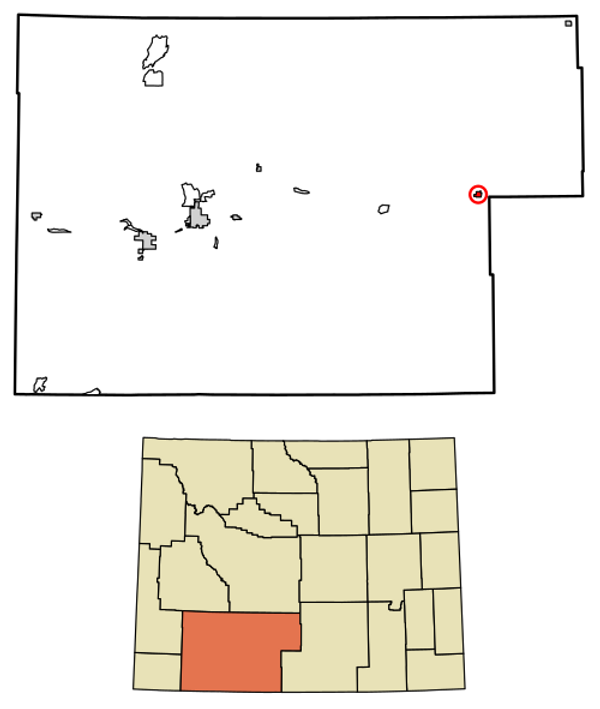
Location where found. 29 March 2026.

Crater in crater. 29 March 2026.

Larger older crater. 29 March 2026.

Impact disk a variant of impact spheres. Usually made as drops from an impact explosion but can be flattened by velocity and hitting a flat surface while still molten. The designs are small impact sphere inclusions and high resonance making outlines around them. The small spheres also made cratering rings contributing to these designs. Resonance designs are what makes shock agates. 30 March 2026.
Texas RockHounds
I found this at Lake Bridgeport. This is the front and back of the same rock. I'm thinking the dark color might be Hematite. It's almost 2"in Diameter and feels heavy for It's size and is not magnetic. Does anyone know what it might be?

Impactite sphere conglomerates - the magnified surface shows cratering signatures. So let me discuss a characteristic of impact cratering. Impact will both pulverize and liquidity. Liquid is the physical response to energy so high that a mineral cannot remain a solid and will liquify and then turn to a gas. Next of significance here is sorting by distance. The common particle is sorted by distance and will vary in size with distance. Most impactites of this nature have small common particle grains called "Constellationing." The presented specimens have larger sized common particle grains as they were closer to the impact center than the smaller grain size. While I admit larger dense configurations are rare but the size of the blast is why. For example a shotgun has similar pellets and the dispersion is high but if it were a cannon less high and so on. Physics forms and fossils - Fossils generally have a high level of organization over most physics forms but this overlaps. In this case magnification shows much variation of the surface cratering. 30 March 2026.
Fossil Identification
Hi there. Found a bunch of these guys near Grand Junction Colorado. I assume they’re fossilized coral but would love to know more specifics if anyone could provide any more information. Thank you!
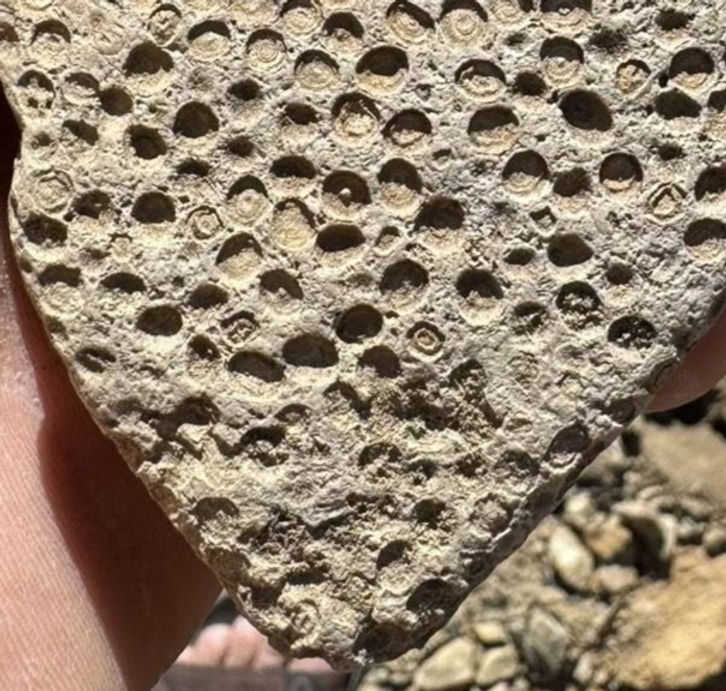

Where found.

crater as shown on gravity map. Roughly 70-mile-wide crater. 30 March 2026.

I don't know or want to know what theory you were taught about oolite origins but this self-collected specimen clearly has a metamorphic and oolite protrusion made at the same time. 3 April 2026.

round impactite spheroid. Lateral sheared top got sliced during flight was still very hot. The surface is a mosaic/wind ripple conditions something like meteorite surfaces make but they will usually show burnt ablation. The most interesting thing is the fractal/dendrite surface side. This is caused by high energy plasma ionization charge it passed through which grounded on it. 1 April 2026.
I found this 1.5" diameter nearly spherical stone along the NM / AZ border. It was only very lightly attached and lifted off the rock it was sitting on with no effort. It was the only thing like it in the area. There are however, an abundance of Apache tears in the area eroding from the tuff.

Chrissy Sprague Donovan False strata where the impact wavelengths imprint. Lower section is crater type crossbedding unconformity (impact rubble). 1 April 2026.

The central iron sphere is a round impactite spheroid. It is iron melted from a large meteor earth impact. The impact melts the impactor and impact surface into a liquid making the round iron drop. The drop ran into the surface mixed blast sludge which formed around it also making a cooling crinkle as it cooled down. 4 April 2026.
Rockhounding For Beginners - The OG!
Can someone tell me what the little rock is? It came out of the larger geode. Located in Ky

Chert/chalcedony, oolites, variable size and color. Impact made from a large earth meteor impact. Why do I say that? First of all, it takes about 3,000 degrees to melt sand a full thousand degrees higher than volcanic lava. Next ocean made oolites are found along the shore and have shells in them when magnified or resemble cave pearls much more consistent and white. Often sedimentary oolite theory contends a complex biogenic process and contradictory physical and chemical processes all of which do not address your specimen. For example sand made round by abrasion as a core for successive build up. Have you ever seen a beach with round sand? It has been there for millions of years. True round by abrasion requires holding the axis firm while it undergoes abrading. Impact on the other hand only takes one proven process, impact heat and pressure. Impact heat can melt sand into spheres a liquid drop a likely result. Now take a look at a magnification of your specimen. It has high variability of grain color, shape and size, just what you would expect in an impact made explosion process. 8 April 2026.
Jessica Sturgell
Anyone know what this is? Smooth texture, Does not feel like sandstone. Some spots are slick with waxy shine. I thought it was some sort of fossil but then realized the whole rock is made up of these round little circles. It’s probably something simple but I’ve just never found one before! Thanks for any info!(:
Arkansas river, NE Oklahoma


Another important issue often neglected in traditional theory is transport mechanism. Why is the rock were it is? With impact it is there because of surface cratering like you see on the Moon and other planets. Even asteroids show impact cratering in space. The Arkansas river in Oklahoma skirts around this large crater in both Arkansas and Oklahoma, see attached. 7 April 2026.

Impactite, even the rocks in the background are impactites. It was very hot. Chert/flint. The groves are made by impact particles at hyper velocities. Impact is an explosion so that is why the particles hit at various directions. The rock was so hot you can see some rivulet flow into the crevasses. This also occurs with meteorites. The most interesting feature is a bird's nest crater. It has tiny impact spheres nested in it from a larger sphere hitting it. That is a rare impactite feature. 18 April 2026.
Hicks Lori
Any idea what kind of rock this is? Found in a creek
( Illinois) thanks


That surface is a high heat mosaic fast expansion. Impactite spheroid type not really that common. I say that because they are drops therefore typically metamorphic. The only part metamorphic on your specimen is the shell but that was not consistent enough to keep it from breaking into 2 pieces. Radiant heat is a slower form of impact heat physics and that is what acted upon this quick made explosion blast relic. I suspect it is from a very early stage in the explosion at initial impact kicking up the local surface with heat explosion baking the outside. I don't think it was ever rock just soil that got blasted outward. 29 April 2026.
Utah Rockhounding Community
On a recent trip to Zion, then Escalante from Texas. I found this in a creek bed on Escalante roadside. I found many cool rocks but this was the only of it's type. Not magnetic.


Galina Impact Spheroid. 29 April 2026.
Cj Hegel
Can anyone help to identify what kinda geode this is. I have never seen one like it.

Impact nodule variant, sphere collisions, high heat mosaic. Lower section has smaller collision craters with shock broccoli a type of mosaic surface. 7 May 2026.
WYOMING Rockhounder
I found this in the badlands outside of Worland WY. Can anyone identify what caused this ?

Where found.

Topo map from Mir-Way, my personal favorite. So the double ring large crater in the center is a type 2 subduction crater with the meteor coming in from the west. 7 May 2026.

Well, the answer is something else. That is an impact nodule. It made a crust but the high heat broke it reveling the conglomerate core. The sucked in portion is also a physical product of the rind breaking opening it up therefore sucking in a section. It is not common to find one and while a chert it was once the local soil.
it is now an impactite metamorphic. 7 May 2026.
Lynn Williams ·May 5 at 6:55 PM ·
Is this a type of agate, jasper, or something else? Found in Seminole County.

Where found.

And there is the crater as shown on the gravity map. It is very likely that this impact occured into the inland sea and the surface was mostly a sand. Based on the size of the crater a guess would be about 60 to 100 mya. 7 May 2026.

boxwork with mosaic cleft, slight cindering. This specimen was very hot when formed perhaps twice the 2,000 degree F heat of typical volcanic lava. Nor does volcanic lava make these designs. Resonate heat is fast like your microwave oven. Also the iron oxide is separated by attenuation. This type of surface effect is called resonate partitioning. What is unique about this specimen is the twin peaks I have marked in orange. That is the interaction of two surface resonances. These two peaks combine and extend to form a square and continue downward connecting with the lower iron oxide circular structures. This is an electromagnetic effect. Impact is an ionizer and metals like iron conductors grounding this ionized charge to a normal state at lower temperatures. 8 May 2026. Marie Underdown specimen collected at Suffolk Beach, UK.
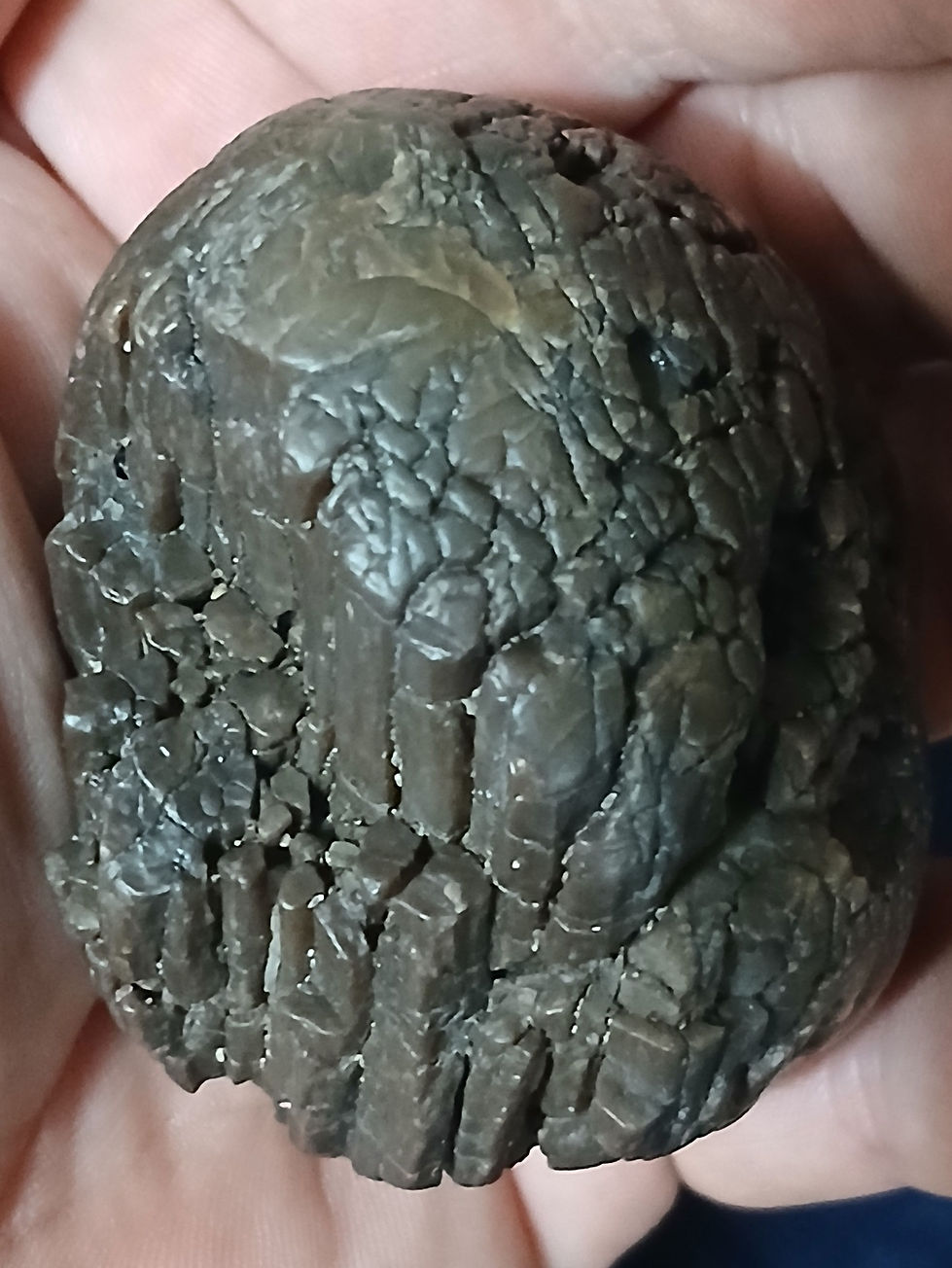
Impact nodule. It does have directionality yet is a type of crystallizing mosaic from the high heat and cooling. It also has a melt fractal on top. Fe3O4SiO2 a product of the iron in the meteor and the local sand, a type 2 impactite. Columnal basalt flow is also an up-splash effect from impact with a tubular liquid compression forming the impact geometrics. Compartmentalized jets of liquid flow is the same thing you see with a bubble wand forming the same geometrics only this is a stream of liquid. 18 May 2026.
Billy Bowen ·
Arizona
Just found this guy


Oblate impact sphere with plasma cavitation and peppering with small impact particles. Fiber crystal in lower right-side section. 19 May 2026.
Arizona RockHounds
What is this

Round impactite spheroid variant - Impact spheres can be most any mineral involved in an earth impact. Iron spheres may or may not be magnetic as impact alters iron at an atomic fundamental level. The most interesting thing about your specimen is the surface. This is called sheet flow dimpling. It is a type of what you see with wind over water. Since impact sphere are melt drops it was liquid at the time of formation and since impactites are ejected at up to 30 miles per second the surface ripples are made by wind flow. Why not meteorite? It is a similar physics, but as other commenters have stated they are not usually round. Is it a concretion? Yes, but not sedimentary. Concretion theory - hail stones are concretions built up in clouds and are usually laminated or composite by this process. Do you see any laminations? This would be true for any sedimentary concretion theory. Impact however can make a melt drop in one liquifying moment. Verified sedimentary concretions - the biggest pearl was 8 inches and not round as all natural pearls are not round. Cave pearls can be round but are calcite and you did not find these in a cave. Iron sediments are thin like you see on rust-stained plumbing. And again, a sediment would be thin laminates or clumps. 1 June 2026.
Elizabeth Brouillette ·May 27 at 1:24 PM ·
I found this in Oregon near highway 5. Sister says meteorite, I have no clue. Super hard, magnetic, heavy and super pitted like a golf ball....

Sheet flow dimpling on water. 1 June 2026.
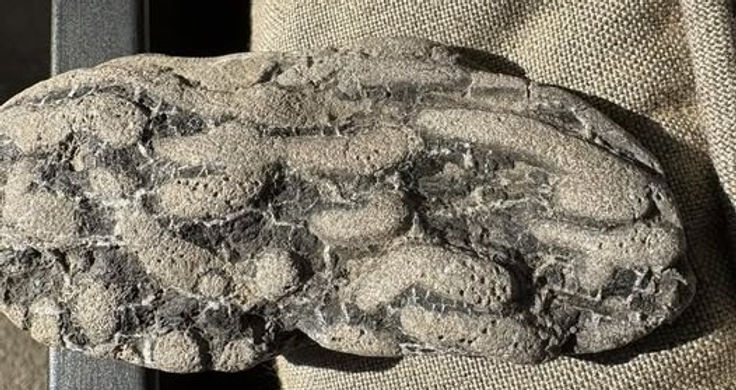
Tube wave structures in dark matrix. This is a velocity variation of impact spheres. The matrix has nano iron from the meteor as iron 3 called a dark matrix. The dark matrix also has white fractals a charged effect based on the higher conductivity of the matrix. The charge comes from the ionization the same way a nuclear bomb interacts with the atmosphere to produce an EMP by ionization. 10 June 2026.
Dean Johnson, Vancouver, WA


Directional ring splatter on Mars. A two-dimensional version of impact spheres. 10 June 2026.
Figure 29. (A), (B) Mars HIRISE infrared image that illustrate perfect sequence of growth and development of collision embryoid bodies in the Mars south pole cap. Identification of Mosaic Order Area of Geometric Triangular Chiral Hexagonal Complexes in Interphase with Morphology Biosignature Pattern in the Interior of Martian Nested Impact Craters
International Journal of Astronomy and Astrophysics
Vol.4 No.1(2014), Article ID:44291,17 pages DOI:10.4236/ijaa.2014.41025
Identification of Mosaic Order Area of Geometric Triangular Chiral Hexagonal Complexes in Interphase with Morphology Biosignature Pattern in the Interior of Martian Nested Impact Craters
Jairo A. Diaz1,2,3, Karen E. Paris2,3

Impact sphere impalement sending out a shock wave crater effect. Some of the iron was atomized in the impact but is being pushed outward by the shock wave. It has developed a halo over time. 10 June 2026.
Deirdre Street Legereit
Can anyone tell me what this might be? I held a magnet to it & nothing.

5P: Round Impactite Spheroid | mysite you can see more of this type. That is an impact nodule of silica iron FeSiO3, at least the surface is. It is not a meteorite even though it has an ablative surface. The wrinkle pattern is a mosaic made because of the shrinking while cooling. Notice that is not the look of flow cavitation. As impact is a multi stage event it is easy for impact nodules to be coated moving through the various liquified materials. 15 June 2026.
Aurora Stromsness
Found in NW South Dakota. Anyone know what it is?
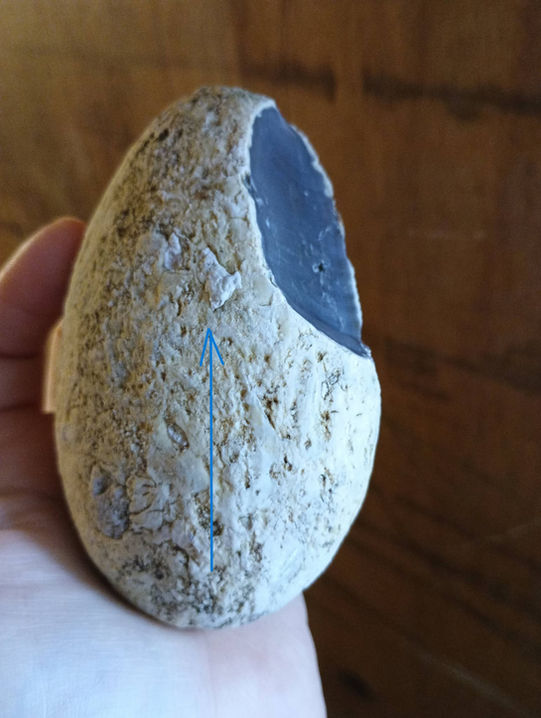
Allright Ashley Person I like technical discussions of impactites. You have an oblate impact sphere. They are made by velocity of moving melt drops and it even has flow directionality of bottom to top chipped section. (see attached picture). Next let's discuss the interior flint. It is a microcrystalline metamorphic consisting of nano pulverized iron 3 from the meteor and silica from the surface which was a sandy soil with shells or limestone as it appears to have some calcite on the surface. Of, course sand and shells mean the meteor probably hit into a shallow sea. Fe3O4 iron 3 is what is used to blue gun surfaces, really more of a blue black oxidation but is much more stable than rust which is iron 2. Now let's discuss various heats. Radiant heat an external heat would heat from the outside in like happens to meteorites from air friction. Resonate heat cooks from the inside out like your microwave oven causing friction of the molecules. Depending on the location in the impact explosion some impactites will be highly shocked by the many shoch waves produced. This cooks the impactite from the inside out leaving the surface least cooked. 17 June 2026.
Rockhounding
Any ideas on what this may be?
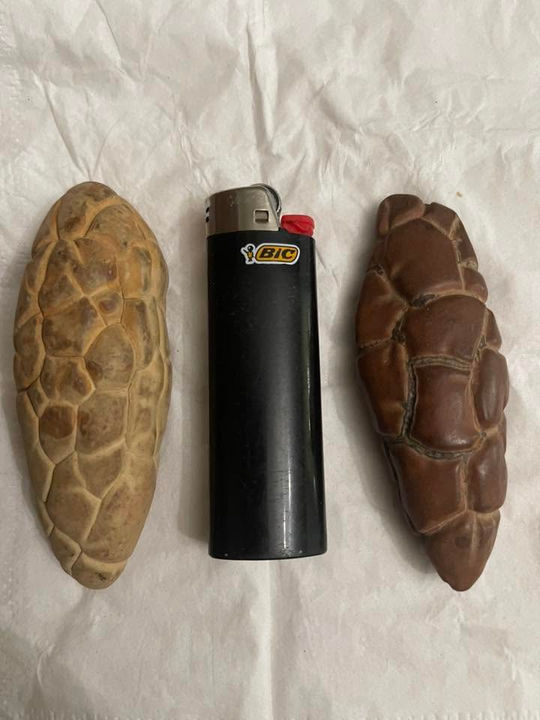
Oblate impact nodules. The tan one surface is a heat mosaic boxwork. The dark one is an energy made etching that grounded on this nodule while in flight. Energy grounding makes the parallel trench crevasses. The grounding energy was a plasma as you can see the stuttering impressions just like you can see when pushing a plasma weld bead. 23 June 2026.
Mississippi fossils & artifacts
I was told they are dragon eggs but I don’t believe in dragons, grinning.

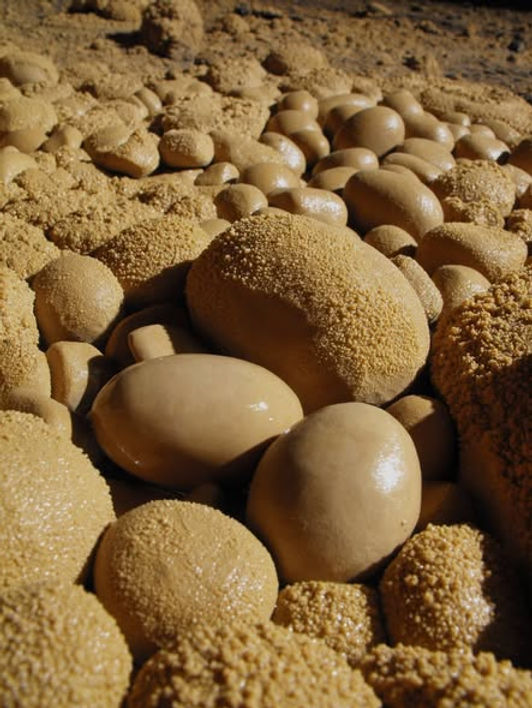
Cave pearls a layering concretion. First notice that perfect roundness is not likely. Real oyster pearls are never perfectly round. Most cave pearls are smaller than 1 cm (0.39 in) wide. Large cave pearls grow as big as 20 cm (7.9 in) in diameter. The world's largest cave, Son Doong Cave in Vietnam, has cave pearls "the size of baseballs".[8] 24 June 2026.
TAG Caver
While surveying a Tennessee cave, we came across these impressive cave pearls! Formed over thousands of years as mineral rich water slowly coats a grain of sand or rock, cave pearls are one of nature's underground treasures.
Finding large, well formed pearls like these is always a special treat.

The Giga Pearl[1] holds the Guinness World Record as the largest certified pearl in the world.[2] The pearl weighs in at 27.65 kg (60 lb 15 oz) and measures 39.37 cm × 22.86 cm × 20.95 cm (15.50 in × 9.00 in × 8.25 in),[3] which is more than four times the mass of the Pearl of Lao Tzu (formerly the Pearl of Allah) which weighs 6.4 kg.[4] There have been other claims of "the world's largest pearl" in recent years,[5] but only the Giga Pearl is certified by the GIA (Gemological Institute of America) as the world's largest natural blister pearl, an indisputable claim. 24 June

And hailstone are a build up process as opposed to an impact sphere which is a drop but also can build up around the initial drop. 24 June 2026.

Oblate teardrop impact sphere off-center nodule. The minerals on the surface and the small patterns on the surface give it away. It appears to have once been bedrock limestone. 8 July 2026.
Keith South
Morning all,
Can anyone help me identify this unusual rock?


Round impactite spheroid - The crust is part of a sequence encountered while exiting the impact crater where it received iron 3 from the meteor itself. The crust was molten and has flow directionality indicating the spheroid was not spinning much. The longer lines crossing it are imprints from shock waves, the smaller lines are mosaic cracks. The core is country rock where the meteor hit. The iron surface delamination is due to the rate of cooling which was apparently fast and it could have landed in water. Also, impactites can travel very fast also making for quick cooling. 14 July 2026.
Candic Linton
Can any one tell me what this is ?

Jeff JW Waddell Outstanding picture. While the impact spheres are layered and have lost surface with higher iron content these spheres do not have the melt flow of the presented specimen. In the context of the picture, you can see the fractal flow toward the strata up splash of this crater. 14 July 2026.
Jeff JW Waddell
Its a concretion ball.
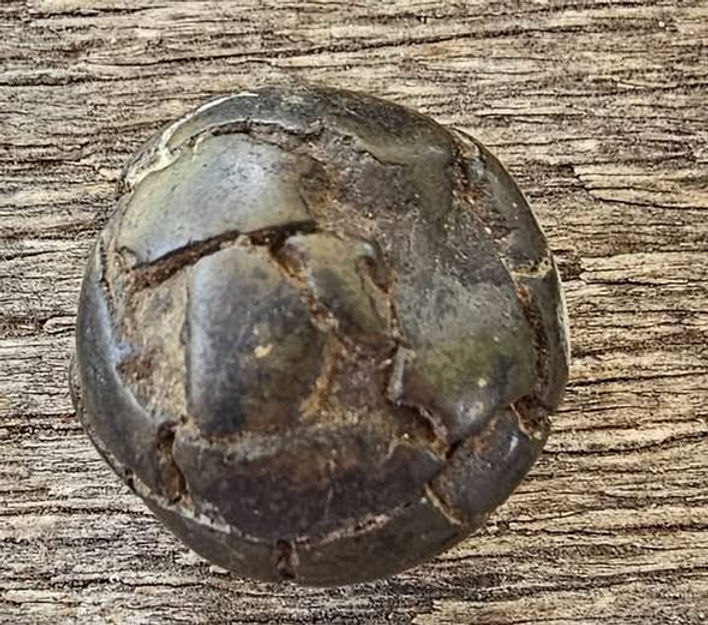
Round impactite spheroid. Impact being a multistage progressive event can have laminations on the melt drops ejecting from the crater. In this case iron 3 from the meteor which was liquid when applied. It has cooled too fast causing the iron to crack into this mosaic. Now let's take a deep dive into annealing and tempering which explains the iron cracking. Martempering (also called stepped quenching or interrupted quenching) is a heat treatment process used to produce martensite in steel while minimizing distortion and cracking. It involves heating the steel above its upper critical temperature to form austenite, then quenching it into a hot bath (oil, molten salt, or molten lead) kept at a temperature just above the martensite start (Ms) point. The part is held at this temperature until the entire cross-section reaches uniform temperature, and then cooled slowly to room temperature Wikipedia+1. This controlled cooling avoids the rapid thermal gradients of conventional quenching, reducing internal stresses and improving dimensional stability. 14 July 2026.
Does anyone know what this is. My friend found it. He’s a vet and mentioned musketball. So I assume it’s heavy.

Pollution condensate? Unlikely but look at the current active volcano map shown below. I think he is correct. 16 July 2026.
Russell Mawson · DeRidder, Louisiana
It fell from the sky and hit my truck it looks volcanic


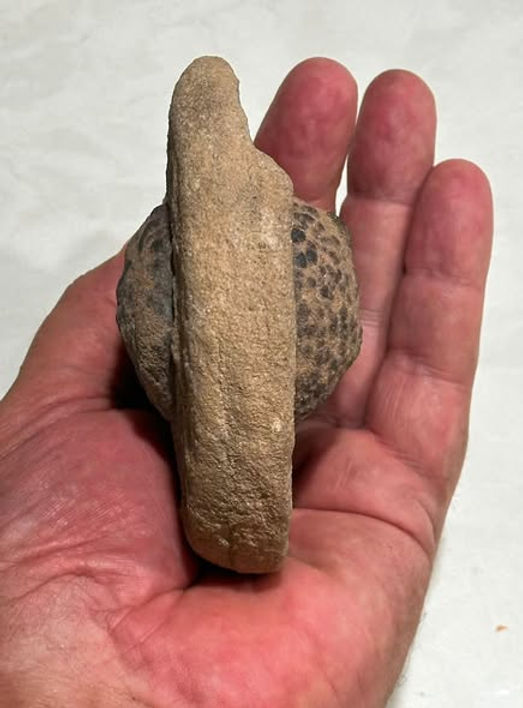
Impact sphere composite variant. The ring is not a catcher it was formed as a pass through more outer part of the impact explosion. It is very likely the ring is a product of spinning. 17 July 2026.
Scott Clark
I don’t know all the fancy words some of you do, but I’m saying iron concretion in sandstone from NE Arizona. One of my faves.


I want to discuss your half sphere. The colored mineral is iron manganese. The specimen is a half round impactite spheroid. The central cavity is caused by expansion like a bubble. These spheres themselves are liquid drops. The exterior has been hit by impalements both solid and plasma bubbles. Now to what I find interesting. If you magnify the interior surface you can see a Potpourri of blast bits, fiber crystals, fractals, fossils, organic material including a tiny cricket, and hair. Your picture has good resolution. I am attaching a magnification of this interesting landscape. 23 July 2026.
Fonda Wood
I have these two rocks. Are they just rocks or something more?

Another interesting thing we have here is the record of the gas expansion blowing this sphere apart. See below. 23 July 2026.
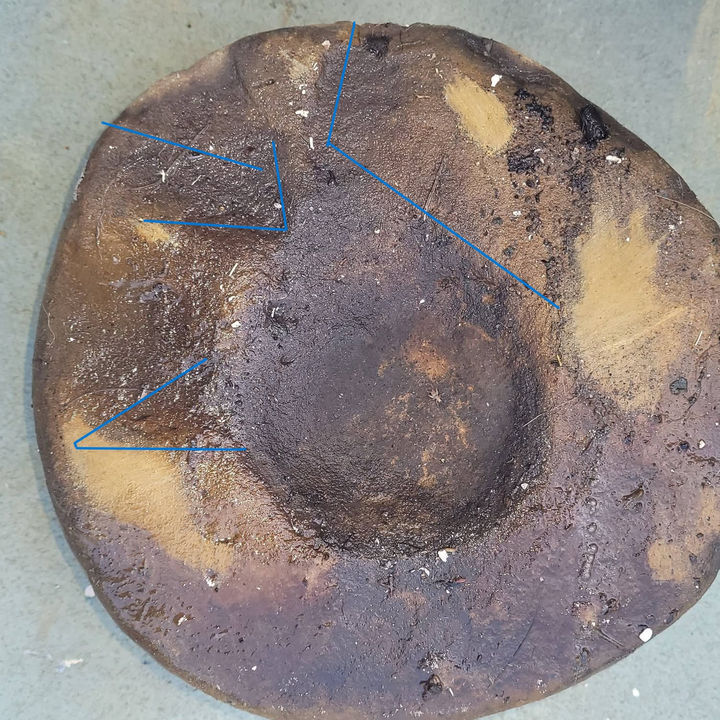

Impactite nodule. The matrix is shock altered bedrock a dolomite variant. The impact spheres appear to be chalcedony. The impalements are at some hypervelocity not great enough to go through and have indented this area of the rock. It is rare to find a specimen with this specific type of impact sphere impalements. Besides that the magnified patterns on the surface are a type of shock made granular patterning called Constellationing. You can see fractal patterning in the lower section. I am adding your specimen to the bottom of this page with a pass through specimen just above it.
Washington Rock Hounds
Any guesses? I’m thinking basalt with quartz crystals but I’m not sure. Found in Pierce County.

Iron impact nodule and chalcedony catcher, rare. You can see the iron 2 halo surrounding the impact also the striations made by the impact along the edges of the nodule. 26 July 2026.
Rockhounding Northern BC
Stuart lake shore. Any idea? The dark round part sparkles in the light. I tried to sand a spot of the middle and did not budge Any guesses what I found?

Impactite sphere variant iron from the meteor. Distal type see tektite chart attached. It also has impalement holes. 26 July 2026.
Valeria Rost of Carmi, Illinois
Has anyone ever seen anything like this?


Impactite sphere cojoined cluster with velocity elongation. The residual iron 2 is from the meteor. Rare. 27 July 2026.
Rockhounding WYOMING
Was wondering if anyone knew what kind of rock this is?
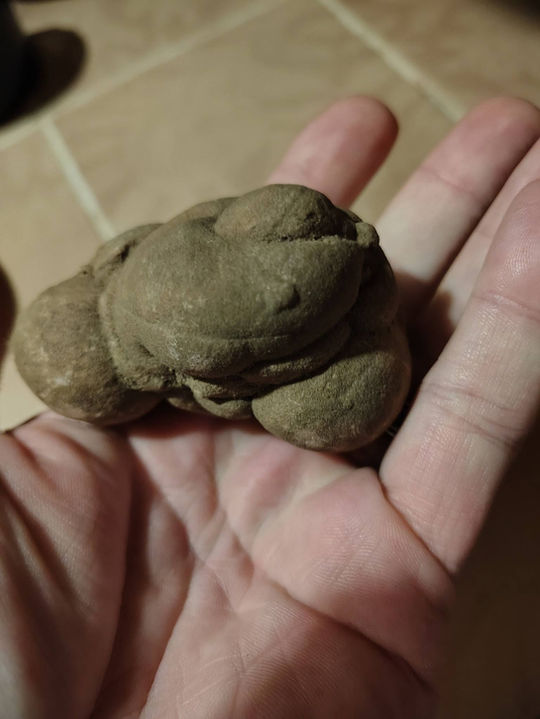
Cojoined impact sphere botryoidal group. Not white as others typically are indicating the presence of nano pulverized iron from the impacting meteor. Will be dense. Density of impact spheres is caused by location in the impact explosion where individual spheres cannot escape. It is similar to things you often see with bubble wands. 29 July 2026.
Oklahoma Rockhounding
I thought old dinosaur poo. And here's the description from my Google lens. Found on lake texoma near caney Creek.

The Caney Creek Crater as shown on the USGS Magnetic Geology Anomaly Map. 29 July 2026.

Impactite nodule, surface is iron 3 black iron oxide or can be blue since it is what we call gun bluing. The round holes on the surface of your first picture are plasma bubble impalements. The designs on the surface are fractal Septarian figures which is basically fractals crossing each other. Impactites are often heave as they have been liquified or compressed in the impact event. Impactites with iron are often not easily measured for magnetism because they have been restructured on an atomic level. It is an interesting example. 30 July 2026.
New England Rock Hounds
Good morning! Thank you for adding me to the group! I found this on the side of a lake and don’t know what it is. Is it a sectarian nodule? It’s 701 grams and feels like solid metal. At first I thought it could be a meteorite but it’s not magnetic. Thank you!


Impact sphere/Geode/Agate/Oolite - Impact sphere expansion is the same property as a bubble as the specimen was so hot it was pliable which is also the bubbling botryoidal interior which explains the oolites and bots. Chert flint microcrystalline with iron 2. 6 August 2026.
Rockhounds of Central Kentucky
I slabbed it! Glad I did. It’s beautiful.

Impactite ring. This was once bedrock is now shock dolomite. Large earth impacts turn both the meteor and the impact area into a liquid to liquid exchange of energy as solid matter cannot withstand that much energy (Chicxulub was 100 million megatons). A melt drop of bedrock flying outward with rotation would turn into a ring also a ring can be formed muck like a crater as an impalement. Drops as spheres are way more common and I would consider this specimen rare. You can get an idea of this type of physics from a tektite chart (see attached). 8 August 2026.
Geo Lens ·
Found in Lake Michigan around the St. Joseph area. Has a natural ring shape and the weight of a stone—any idea what a piece like this could be?


Impact sphere with curvilinear flow fractal. It appears to be an iron sandstone. It has tiny pits in it which are from impalement during the impact explosion storm. It is rare. 14 August 2026.
Travis Penselin
Can anyone identify this rock