
Wisconsin Impact Craters


<< Crater
Crater >>
<< Crater
Crater >>


Jannette Kristine Kodesh Barron County Specimen. Dark matrix with impact particle forms. The green is hard to say, perhaps some nano copper or olivine. The red brown tone in iron with silica of course the dark matrix is black iron oxide Fe3O4. The red dot is iron or manganese. Is this specimen valuable? Yes, because it is bits and pieces of an impact and probably would make a nice cut and polish but really is not one rock you are looking for it is just the getting out and discovering.

Impact mosaic with impalement. Wisconsin.

Jason Robey · ·
Found in Clark county Wisconsin

Oblate impactite spheroid Fe3O4SiO2. It matters not if it is magnetic as shock which formed it will alter magnetism. The surface is plasma impalements. Not a fossil as you can notice the plasma impalements push against each other forming impact geometrics like squares. The elongation is from its velocity when it was formed as a bubble therefore elongated. While not the most common impactite these spheres are one of the most common to attract interest. Nov. 25, 2023.
Patrick Schmitt · ·
Found in a creek in Central Wisconsin USA. It's different than what is the majority of rocks. Not lava as it's dense and heavy. Looks like a big egg with dimples. Probably just a rock but it caught my eye

Impact craters the source of earth's minerals, like banded iron. Nov. 25, 2023.

Topographically visible craters have not been erased by subsequent geological events like more craters. Nov. 25, 2023.

Impact made sheet wave phenomenon. You can see this on water with a tuning fork make this shallow surface ripple effect. This is also how it was imprinted. Jan. 8, 2024.
Susan Staben Richards
This rock inspired me to become a geologist back in 1974. I took geology 101 at the U of Illinois and they took us on a field trip to Baraboo, Wisconsin (USA). This beautiful pink quartzite preserves some original sedimentary features. I did not get back there until I was a retired geologist and my daughter had moved to Wisconsin. These photos were taken at Devil’s Lake, Baraboo, Wisconsin, USA.


Impact sphere receiver. The St. Croix Valley Impact Crater is shown above with star. May, 12, 2024.
Lorenzo Fuentes · ·
Old cemeteries never disappoint.
INTERNET SAYS “This is the very interesting grave marker of Thomas Toberman in the historic Prairie du Chien cemetery. (Please respect all cemetery rules posted at the entrance.) There is a lot of speculation about this unusual-looking stone and its origins. Whether the marker is a meteorite, a rare stone formation, or something else…I’ll leave you to decide for yourself after you see it. I hope you enjoy.
Before dying, Mr. Toberman requested that this unusual rock be used as his headstone in the cemetery. Permission was requested from the Evergreen cemetery board to place the stone. After permission was denied because it wasn’t a “real” engraved marker, it mysteriously showed up on his plot the following week.
Meteorite? According to an article published in a local newspaper (the Courier Press) a few decades ago, the marker is a meteorite that fell as a fireball on the deceased’s farm when he lived in the Prairie du Chien area. From the looks of it, it is easy to imagine that it came from outerspace and became deeply pitted as it burned through earth’s atmosphere.
Meteor-wrong? Another theory is that it is a rare stone formation that can only be found in 2 or 3 places in the world (the St. Croix valley in Wisconsin, someplace in China, and possibly someplace in Arizona). This theory is that it is made of limestone that was eroded into its current shape by swirling vortices of water. According to this story, Mr. Toberman discovered the rock in the St. Croix River valley while working there as a lumberjack.”.... https://www.facebook.com/groups/1576487499800058/?mibextid=NSMWBT

A better map of Wisconsin Craters. These state maps fail somewhat for craters extending beyond state borders. May 12, 2024.


Oolite transition and shock melt. I like oolites. When doing field work I came across a specimen around Sparta, TN in an old quarry. I noticed it was a transition form. Here you can see the production of the impact spheres and the shock melt. Shock melt is a resonate energy like your microwave and cooks from the inside out, gathering around the center of mass. The iron is from the impacting meteor/bolide. Sept. 22, 2024.
Sam Lubbe
·
Silicified oolites, grant county. Looks a bit like fish eggs, I think.

Grant County.

Impact expansion nodule tektite/agate, rare. I am fond of the tektite charts that show the formation principles, see attached. This was a melt drop from the kinetic explosion when a large meteor/bolide hits Earth. https://www.researchgate.net/figure/Flatted-3D-model-of-bubble-complex-tektites-left-and-right-compared-to-a-snake-skin_fig1_353759105 Sept. 27, 2024.
Tim Brown specimen, Lake Superior.


Impact nodule high shock melt is a proto cinder. Oct. 15, 2024.
Tanya Overlien · ·
Hello everyone! I’m new to rock hounding and could really use some help with identifying specimens. I found this in the Kickapoo River (Driftless area) in Wisconsin. First 5 are wet pics, last 2 dry with different lighting. TIA!

The Kickapoo runs out of a two crater conjunction. Oct. 15, 2024.

Impact basalt. Why do I say that? I just saw the Wetumpka Impact Crater in Alabama and saw similar underlayment. Also keep in mind the drusy sparkles are tiny sand grains which would be distributed as an impact into a sand surface and not as an igneous or volcanic process. Attached is a picture I took. Oct. 16, 2024.
Kade Black
Hello. These came from Marathon Co. I think it’s black granite? And it really looks like there’s gold in it, but maybe just wishful thinking. What do you guys think? I’d love your feedback. The pics and videos aren’t very good but I tried to capture the sparkly nature of the black and the gold.


The radon enclosures of Wisconsin. Radon is the breakdown of uranium. So where did the uranium come from? I think the answer lies in the distribution patterns. They are making crater type outward impact tectonic patterns. While the attached maps differ, they also present similar macro results. Oct. 16, 2024.


Native copper. Wisconsin even has a Copper Falls State Park in the upper state. Native copper can be found in fractal and crystal pseudomorph configurations. While sedimentary geology contends that some toxic sea deposited these it is very unlikely. As with all of sedimentary concretion/precipitation theory it fails to identify where the copper and toxic chemicals came from. The oldest of these theories goes back to the 1900's called an earth crack spring release and was later named Mississippi Valley Theory (MVT). No such earth cracks have ever been found to validate this theory. You can make a specimen like this using copper sulfate and a carefully constructed battery apparatus. A specimen this large would require a 55-gallon drum. Pure fractal ores can be found as other minerals including gold. Since gold is inert it is very unlikely it formed by any chemical reaction/precipitant. Impact theory contends that this specimen was ejected as melt from an impact explosion where the meteor contained the mineral. This theory explains the presence of the ore and its refinement in a high heat and pressure. Impact also contains its own electricity as explosions this large like nuclear explosions produce a plasma ionized core which will make an Electromatic Pulse (EMP). Fractals are an expression of a charged event like lightning. Crystal pseudomorphs are an expression of shockwave overprinting. Similar specimen from Michigan attached. https://www.mindat.org/photo-83199.html 24 Dec. 2025.
Boulder Marine ·15h ·
Howdy, new to this rock hounding hobby, boy is it addicting! Anyway I have a picture of a copper piece that I found in my mothers things, any idea how this would form? Thought I would ask some people that know more than I do.. Thanx in advance! James

The connecting nodule construction is caused by a pulsing wave. It is the same principle that makes columnar basalt. 24 Dec. 2025.
Impact clast - I first found these at Howell, TN in my first week of my six-year study of the crater. Even a relatively small one had to be loaded with a backhoe. Why are they so dense? Rarefaction compression. Shock from earth impacts is a wave form and the compression side of the wave compresses these impactites and the shock friction makes them liquid as solid matter cannot withstand this level of energy. It was once bedrock and now is shock dolomite. So why the two colors? When formed it was in a viscous state of blobs some getting nano pulverized iron from the meteor then fused together. The fractals - impact is a very high charged event with all the minerals jumping to ion states from the high heat releasing charge that dissipates on the impactites. Limestone is a poor conductor, but this is very high charge physics. Solid versus twined fractals - The solid fractals are a lower state of energy than the hollow twined fractals shown on your specimen as the hollow type are the same you see with fulgurites. Fulgurites are lightning made rocks. You can see this giant crater covering the whole state on the Chegg Products & Services Geology Anomaly Map. Attached. 19 May 2026.
My son found this one ten years ago in a small river in Waukesha county and we are looking for someone that might know what it is. Roughly the size of a football but weighs about 20 pounds.


It's a groove thing. Depending on the angle this quartz impactite was tumbling in the impact blast it got hit with plasma iron from the meteor. As a relic the iron is presented in iron 2 (rust color) and iron 3 (black). I think iron existed in both states at the time this impactite was formed. The combining with the quartz has stabilized it. 24 May 2026.
Johnny Cutler
I found this in Northern Wisconsin. I have never found a rock like this. Any ideas ?

I call these topo craters. It is much like the surface of wounds as a doctor might examine. To see what all the damage is below you need an x-ray or MRI. 24 May 2026.

Round impactite spheroids, shock marble, iron is from the meteor. Impactites can often be found together as in a strewn field. The level of depth represents time since the earth impact crater was formed. The crater ring is still visible topographically. Left specimen shows iron plasma bubble flow pulsing a common physics you can see with plasma welding. 6 June 2026.
Wisconsin Rox
Okay rock hounds, can any of you figure out what these may be? My dad was an excavator operator, and brought home a couple hundred of these from the job site in Waukesha county. I was a sophomore in HS, so about 1970. Some different sizes and shapes. My buddy and I took them to our HS science teacher but he was stumped. They are super hard; we hit them with a sledge hammer and they did not crack, just bounced straight up in the air a couple hundred feet, zero marks on them. Propane torch did nothing. It took a couple months and we finally figured out what they were. I probably have 25 to 30 left. And I drew tiny little faces on them in pencil. Any guesses?


Where found.

Yes the bottom crater which is later than the one above appears to be a slider low angle impact from the south. 6 June 2026.


Impactite, flying shards impalement one side directional. Rare. Appears to be quartz shards. Trace iron which would be from the meteor. 5 August 2026.
Geo Lens
Found in Lake Michigan (Kenosha, WI): looking for identification help on a piece like this.

Impactite pebble banded harmonic jasper with iron as citrine and blue as manganese the specimen is a chalcedony. It is an off-center harmonic. 28 August 2026.
Nicole Warner · Found in Wisconsin
My 6 year old said “mom look what I found!” When I picked her up from summer camp today

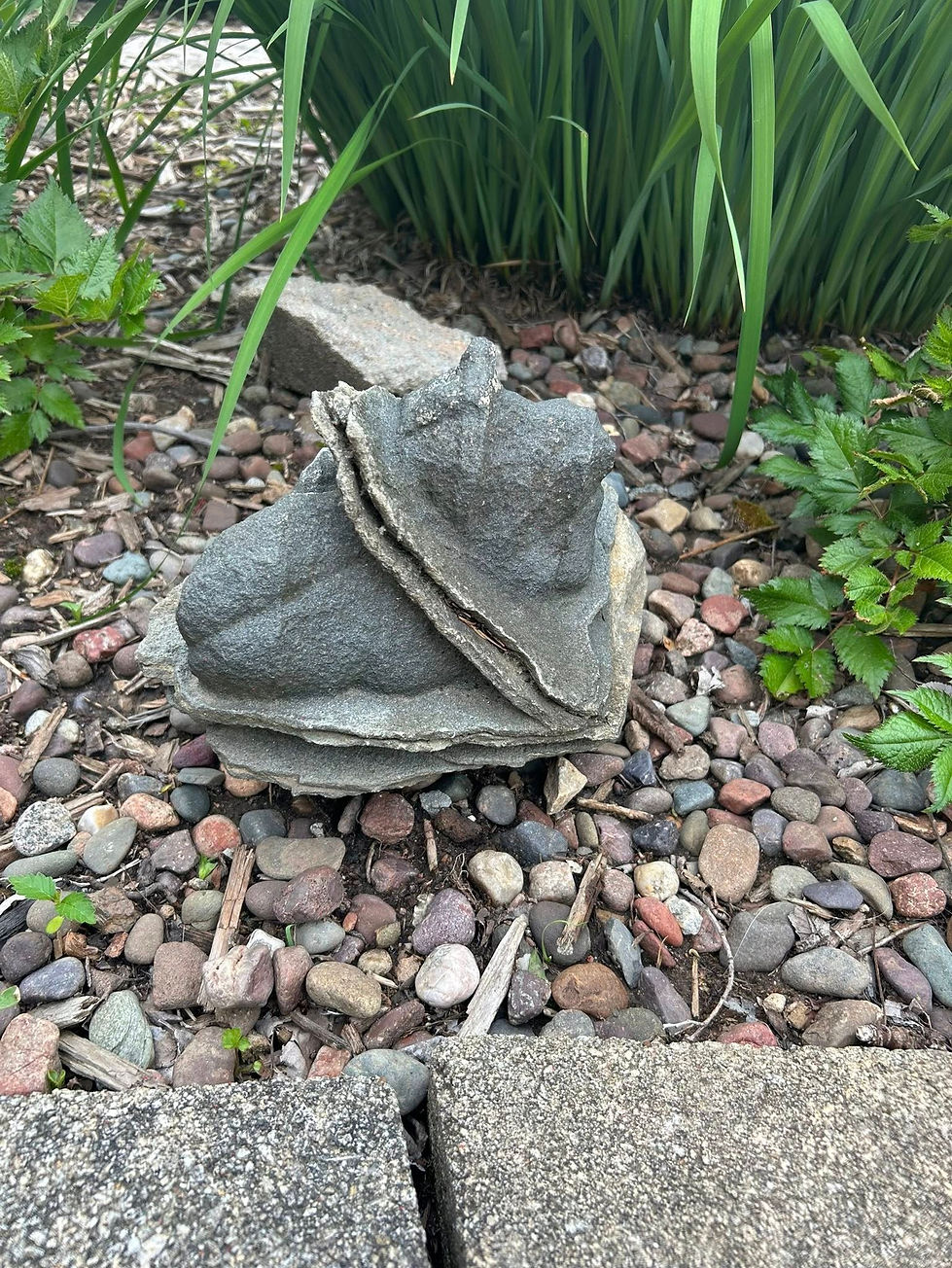
Linear Constellationing - This impact clast has large grains in linear alignment. While shist has large grains it is also tends to cleave in laminar layers. That is not going to happen with this boulder. Impact shock can make very hard boulders. The green rock at the left side base is a copper impact cinder. Back to the boulder, the horizontal banding is the shock wavelength imprinting. The linear grain alignment is a harmonic noise called Tiger Eye. On the attached picture you can see an oscilloscope with harmonic noise. So, let me discuss impact grains. I first encountered this curious structure in the Howell, TN Impact Structure. The grain particles are pulverized rock put back together by the impact pressure. Impact pressures are measured in the Giga Pascals (GPa). For reference the first atomic bomb made Giga Pascal pressure of around 14 GPa. Earth impact pressures will go off the scale to melt or evaporate rocks. Having said that you find a specimen like this near to impact centers, and the same is true for that cinder. 6 Sept. 2026.
Wisconsin Rox
Any ideas what this could be? Found at a county park in Walworth County.

